645 Thought Leadership
Autonomous Intelligence
Nobody trusts AI past 20% of the work. Closing that gap, one function at a time, is the biggest investable category of the next decade.
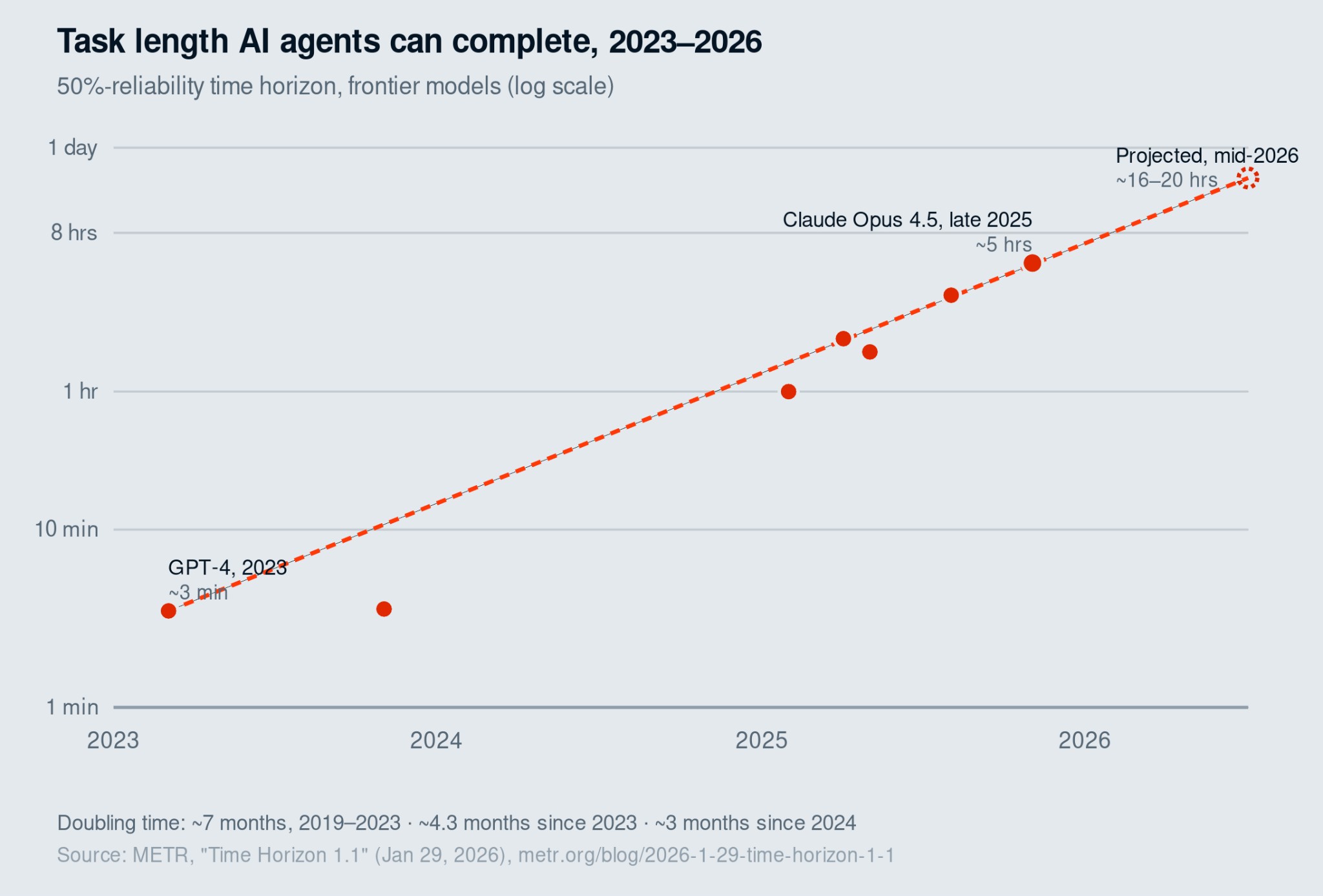
In 2023, the best AI coding agent could reliably handle about three minutes of work. By late last year, it was five hours. METR's been tracking this — the length of task an AI agent can complete — since 2019, and the doubling time has compressed from seven months to roughly four. Extend the line, and frontier models right now sit somewhere around 16 to 20 hours of autonomous task length.
That's the chart everyone in this industry keeps pointing to. It's not the number that matters.
Here's the one that does: developers already let AI do roughly 60% of their work. But they won't leave it alone for more than a fifth of it.
That's not a speculative number: that's what Anthropic reports. According to their 2026 Agentic Coding Trends Report: developers use AI in about 60% of their work, but report being able to fully delegate only 0 to 20% of tasks, where no human is checking in. Anthropic had every incentive to round that number up. Luckily they didn't.
The wrong question
Is this the year AI crosses into something like general intelligence? Every few months, someone credible says yes. Sam Altman's been making versions of this argument for a while now, from agents doing real cognitive work in 2025, to agents producing novel insights in 2026. He might be right about the capability curve, but it's not the argument worth having.
The frontier labs don't even agree with each other on it. Mira Murati's Thinking Machines Lab published its own position just days ago: "The Future Worth Building Is Human" argues that keeping people meaningfully in the loop is the goal, with customizable models, wider human-to-machine communication, weights people can actually own. From her seat, it's a technical problem to solve, not a limit on how capable AI can get.
Capability was never the constraint. Trust was. A model can be extraordinary at a task and still never be used unsupervised, because "extraordinary most of the time" isn't the bar for something you walk away from. Call it what you want. We call it execution > hype. The interesting number isn't how good the next model is. It's whether the 20% moves, and what actually moves it.
Autonomous engineering was the pilot, not the point
Code was always going to go first. It's the one domain where "did it work" resolves in seconds — tests pass or they don't, deploys succeed or they roll back. That's an unusually forgiving place to learn how to close a trust gap, and we've watched it happen in real time, deal after deal, across the autonomous-engineering pitches that have crossed our desk this year.
What closed it wasn't a smarter model. In practice, it looked like context engineering, memory management, optimizing prompts and harnesses — three unglamorous things, really: reliability you'd stake a production system on, observability so you can see what an agent actually did and why, and self-healing so the system catches its own failures instead of paging a human at 3am. An agent that can write code is not the same as an agent you can walk away from. That gap is exactly the 20% problem, and the businesses worth backing are the ones closing it.
The pattern is already leaving code
Engineering isn't the only place this is happening. It's just the place it started.
ServiceNow has said publicly that AI agents already automate 37% of its own internal customer-support caseload — not a pilot, its own production operations. And this is the destination Anthropic's own CEO has described directly: AI systems handed tasks that take hours or weeks, going off to do them autonomously, "the way a smart employee would, asking for clarification as necessary." Not a startup's roadmap. A frontier lab's own stated plan for where this goes — into domains with real regulatory and financial consequences, not just code.
Neither of those is about coding. Both are running the same playbook engineering ran first: prove the agent works, then prove it can be trusted, then watch how much gets delegated once it can.
What closes the gap, in any function
You need something that catches failures before a customer or a regulator does. You need a record of what the agent actually did, not just what it was asked to do. And you need someone — a person or a system — who's accountable when it's wrong, because "the AI did it" has never once been an acceptable answer inside a real company.
That's not one investment thesis. It's four. The infrastructure that closes the gap has four distinct layers, and each one is durable on its own:
Everyone builds — the precondition. When anyone can produce software, the shortage moves to whoever can be trusted to own what got built. That shortage doesn't shrink as models improve. It gets worse.
Managing the chaos — the coordination layer. Ten thousand small applications, shipped by everyone, need someone accountable for all of them — not just the ones an engineer wrote. The job scales with volume, not with model quality, so it never goes away.
Autonomous engineering — the working prototype. The specific reliability, observability, and deployment infrastructure that already closed this gap once, in code. Durable because every team that adopts it makes the tool smarter about its own stack, not just faster in general.
The Actual Cost of AI — the constraint underneath all of it. Every one of these systems runs on inference, memory, and compute that cost real money every time they're used. That's a metered cost structure that doesn't disappear no matter how good the model gets — a different animal from the zero-marginal-cost economics software used to run on.
The scoreboard
We don't think the next model release is the number to watch. We think it's this one: how much of the work in front of you would you let AI do without checking. Right now, even at the company most incentivized to say otherwise, the honest answer tops out around 20%.
We're not backing whoever gets to a bigger model first. We're backing whoever moves that number.
If you're building the thing that closes it — in engineering, or wherever it goes next — that's the conversation we want to have. Come find us.